
Quote of the book
“Suicide is not selfish. Characterising suicide as selfish simply adds to the stigma around it. And when stigma increases, help-seeking declines, ignorance flourishes and deaths soar.”
5 key points
- Suicide is a marker of distress and not attention seeking
- There is a public health need for more suicide awareness, because of growing health inequalities and sociodemographic differences; even though anyone can die from suicide, there are differences socially.
- The feeling of entrapment plus past suicide attempts were the biggest indicators for dying by suicide.
- Asking if someone is suicidal or if they have a plan does not cause them to die by suicide; rather, it can help them to get the help that they need.
- For people who are suicidal, tasks that many people take for granted become an opportunity to fail and let others down, because of the pressure for perfectionism.
Review
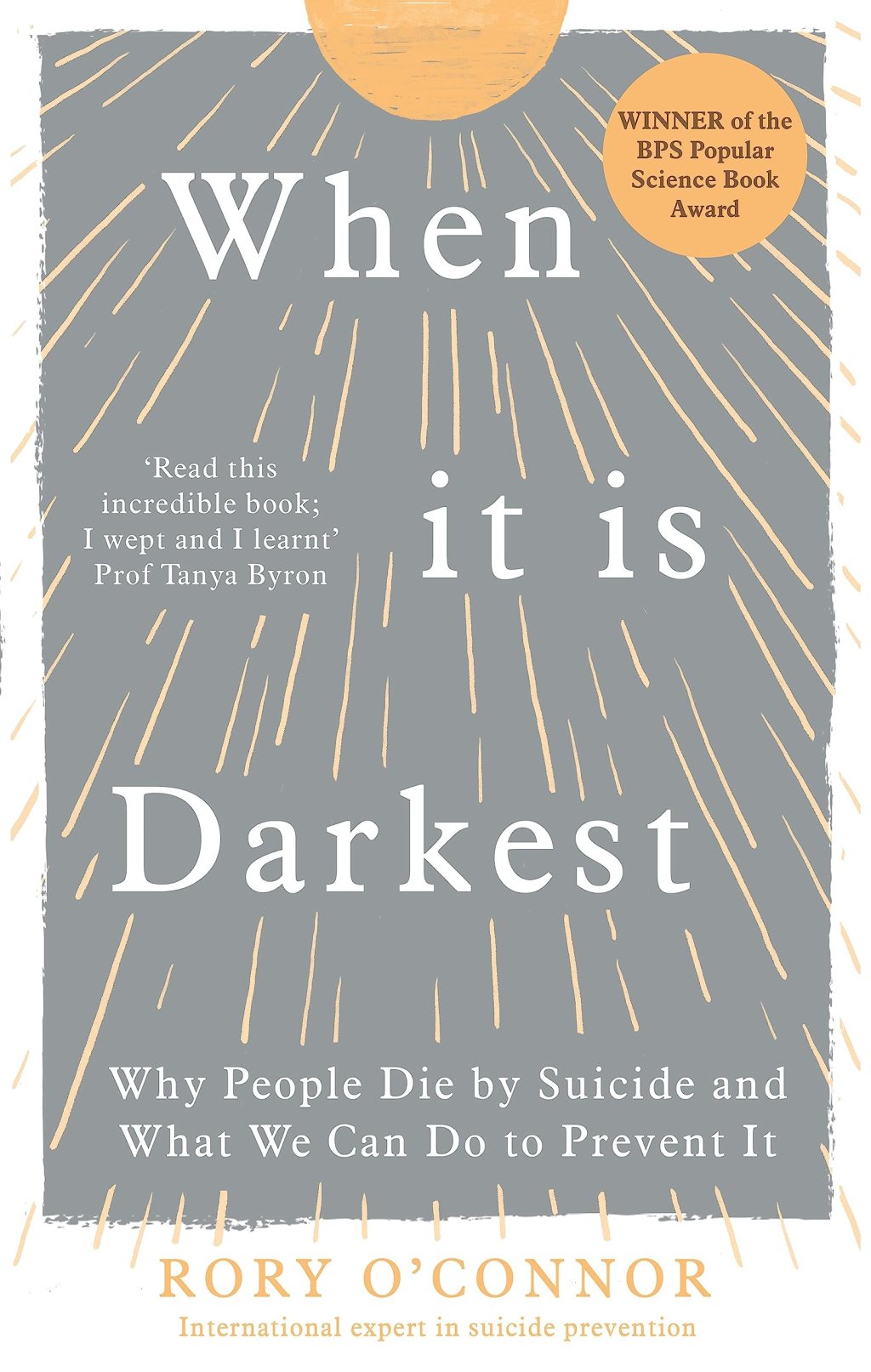
Professor Rory O’Connor is one of the leading voices in psychiatry and suicide research. He is a distinguished academic in psychology and psychiatry who has dedicated his career to understanding one of the most urgent and complex issues in mental health: suicide. In his book When It Is Darkest: Why People Die by Suicide and What We Can Do to Prevent It, Professor O’Connor brings decades of clinical experience and research into an accessible and compassionate book, that explains why people die by suicide and how society can respond more effectively.
The book comes at a time when there has been a growing global attention to suicide, published after the COVID-19 pandemic, when more attention was given to mental health crises, and more awareness of persistent health inequalities came around. Suicide is one of the starkest markers of inequality across socioeconomic groups, even though suicide doesn’t discriminate and can affect anyone. Professor O’Connor’s book has awareness of this, with emphasis on the statistical patterns that show clear public health disparities, alongside the intensely personal and often unpredictable nature of individual experiences.
This book also draws light to O’Connor’s Integrated Motivational-Volitional (IMV) Model, which offers a framework for understanding how suicidal thoughts emerge and when they might lead to suicidal behavior. He dispels a series of common suicide myths, namely:
“1. Those who talk about suicide are not at risk of suicide.
2. All suicidal people are depressed or mentally ill.
3. Suicide occurs without warning.
4. Asking about suicide ‘plants’ the idea in someone’s head.
5. Suicidal people clearly want to die.
6. When someone becomes suicidal they will always remain suicidal.
7. Suicide is inherited.
8. Suicidal behaviour is motivated by attention-seeking.
9. Suicide is caused by a single factor.
10. Suicide cannot be prevented.
11. Only people of a particular social class die by suicide.
12. Improvement in emotional state means lessened suicide risk.
13. Thinking about suicide is rare.
14. People who attempt suicide by a low-lethality means are not serious about killing themselves.”
For example, he notes that suicide is not about attention seeking, but rather a market of distress, and that suicide itself isn’t inherited, even if the vulnerability to suicide could be. Professor O’Connor also emphasises how complex the reasons for suicide are, that it is not always caused by a single factor, but instead a series of interacting, visible and invisible factors. Even those closest to the individual might not pick up on the factors.
When reading the book, I reflected particularly on chapter 6, which discussed the concept of “entrapment,” developed alongside theorists like Paul Gilbert and Steve Allen. Professor O’Connor explores how both internal experiences (unbearable thoughts, shame, hopelessness) and external conditions (defeating or humiliating life events) can lead to a psychological state where escape feels impossible, thus leading to the feeling of ‘entrapment’. When efforts to resolve or escape these pressures are thwarted, suicidal thinking may emerge.
Other interesting themes that Professor O’Connor touches upon include the roles of social perfectionism and neurodiversity on the risk of suicide. Traits like the constant need for approval, fear of failure, and an overwhelming pressure to perform can leave individuals feeling like burdens or failures, where any task can become an opportunity to fail or let others down. Autism was also noted to be a higher risk factor for suicide.
Whilst it is challenging to propose solutions, Professor O’Connor emphasises that suicide is often preventable and therefore public health has a key role to play here. Key protective actions include following a series of steps, such as identifying suicidal intent, assessing whether someone has a plan, how detailed it is, and whether they feel they can keep themselves safe.
Overall, Professor O’Connor’s book, When It Is Darkest: Why People Die by Suicide and What We Can Do to Prevent It, is eye-opening for anyone who is interested in understanding a condition overpowered by myths and misconceptions, to gain clarity and empathy for it. This book addresses this topic in a serious and sensitive manner, contributing meaningfully to the conversation about suicide prevention.
Overall rating: ⭐⭐⭐⭐⭐
 Preeti Kaur