Quote of the book
“It’s easier to believe that sick kids always get better and death comes only for those who’ve lived a full and fulfilling life.”
5 key points
- Human presence and connection is a powerful healer at the bedside of those who are at their most vulnerable: “In medicine, the greatest act of courage is sometimes simply staying in the room.”
- Palliative care goes against the stereotype of medicine: you are no longer saving lives, but now healing lives, to make the time meaningful and comfortable for the children.
- Children, even with very few years of life experience, can be the biggest teachers of how to live a meaningful life.
- Faith and medicine coexist and inform each other, as reflected in Dr Macauley’s theological background.
- The parents are as much patients as their children, due to the grief and grace that they have to carry at the loss of their child: “Saying goodbye to your child is such a profoundly unnatural thing for a parent to do.”
Review
Dr Bob Macauley is one of the few pediatric palliative care doctors in the United States, with a very personal story for why he chose this career. He came from a theological background, initially as an Episcopal priest, before moving into ethics in medicine, then pediatric palliative care. He said that whilst he loved theology, “in the end, (he) chose medicine because at least there, (he) could try to stop the suffering”, and he starts the book with this vulnerability that he carries on throughout the rest of it. Dr Macauley has delivered TEDx Talks on palliative care, as well as fulfilled some of the dreams of his paediatric patients such as meeting the cast of Wicked, in their final days. He describes how he found meaning beyond the role of healer.
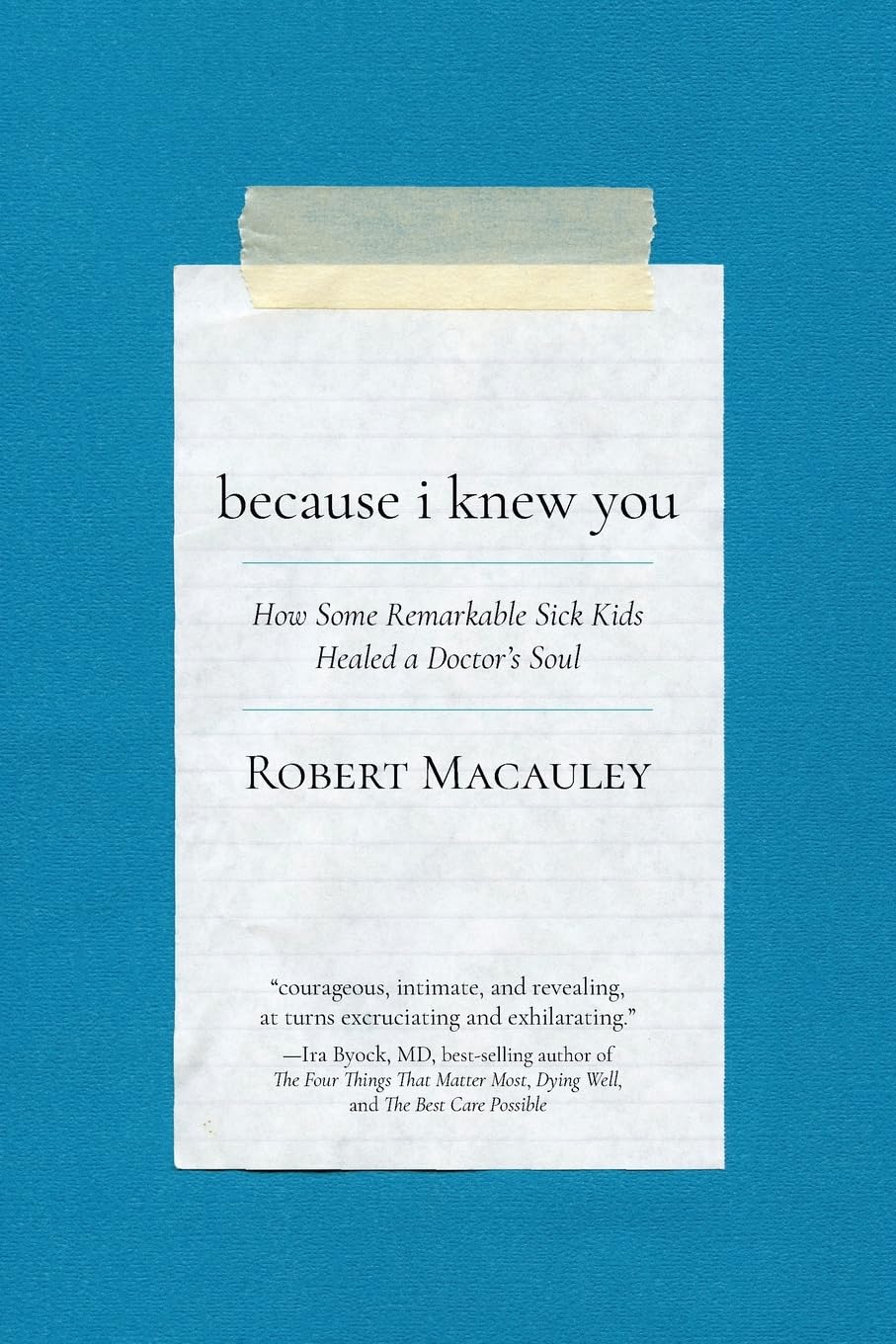
At first thought, his job sounds overwhelming, and many people told him that they were glad they didn’t have his job. However, Dr Macauley has had a lot of pride for his job, working alongside people who “understand that palliative care is more about living than dying”, that his patients remind him on a daily basis about living. He brings these reminders in this book: because i knew you: How Some Remarkable Sick Kids Healed a Doctor’s Soul, a memoir that combines medicine with philosophy. These lessons and stories are some that he shared within his book, learned from the children he cares for and their families.
His book explores a range of stories from a baby which was born with conditions that were described as “incompatible with life”, who is still fighting strong a decade later, and a teenager with the devastating condition of cystic fibrosis, who travelled in Europe to concerts with their oxygen tank, and a girl in high school who got cancer and flew to see a Broadway show the weekend before she died. These stories reflect the overarching theme of the book: that healing happens in the soul, not just the body. Other key themes from the book include the weight of love, loss, being present, and grief.
One thing that makes this medical memoir more poignant than others is that it is a brutally honest and unglorified view of medicine. He focuses on the power of presence, where it is acknowledged that things can no longer be fixed, but that he can still be there. This goes against the instinct as a doctor to heal and fix, noting that “we doctors are fix-it people, trained to prevent death, not to prepare patients and families for it.”
One standout story is that of Nicky, a teenage boy with Hunter syndrome whose mother, Lorraine, has fought for his dignity his entire life. When Nicky ends up in the PICU on Christmas Eve, Dr Macauley is called to help the family face the impossible. He doesn’t push or persuade, but he listens. When Nicky’s mother asks when she will know it is time, Dr Macauley replies with a gentle but moving line of “I think Nicky will tell you”, which reflects the power of presence that Dr Macauley continues as a key theme of this book.
Dr Macauley also discussed his early experiences from medical school, remembering a young patient called Hannah. He plays games with her with toy phones, passing the time, and he later finds out that she still pretends to call him daily. This reinforced to him how much his simple act of presence has an impact on Hannah. He didn’t realise how much he mattered to her. Dr Macauley comes across as a very humble doctor in this regard, not realising the relationship between what he has offered his patients and what his patients feel from his presence.
As much as Dr Macauley shares the stories of his patients, he writes a very personal memoir too. He reflects on faith, the moral doubts and uncertainties he has faced as a physician, and his own grief, all whilst being sensitive to not preaching. He draws on some big ethical questions too, including suffering, equity, and questioning at what point a physician has done “enough”.
Overall, this book is a sombre, heartwarming, and hopeful memoir of being a paediatric palliative care doctor. It is essential for anyone interested in palliative care, ethics, or who wants to learn more about what it means to live, truly live. The stories of the children that Dr Macauley shares in this book will teach what that means and the truth of the power of human connection.
Proceeds from purchasing this book go to support the paediatric palliative care program at Oregon Health & Science University, where Dr Macauley is the medical director, and a proportion is also shared with Darkness to Light, which is an organisation that prevents child sexual abuse.
Disclaimer: I received an advanced reader copy of this book in exchange for a book review, for which I thank Mindbuck Media.
Overall rating: ⭐⭐⭐⭐

