
Quote of the book
“There’s zero correlation between being the best talker and having the best ideas”
5 key points
- Susan Cain describes how we can adapt our primary schools, secondary schools, and workplaces in order to make them more inclusive for those who prefer non-group activities, for example by not having open plan offices.
- Society makes young people internalise the message that they should be outgoing. Children are often encouraged to be outgoing and to play with other children, whilst being singled out if they are quieter or prefer their own company and solitary activities.
- There are three ways that you can discover what your personal projects are (based on Cain’s personal experiences):
- Reflect on what you enjoyed as a child
- Notice what you gravitate towards
- Look at what you envy in others
- One way to be a better leader as an introvert is to find styles of communication which feels true to yourself in which you can best express yourself. For example, communicating through writing instead of verbally. She shares the example of Eleanor Roosevelt: she was introverted and disliked speaking publicly, but she found a social issue she cared about, pursued her passion and made a huge impact in public life.
- Introverts have made significant contributions to society, such as Rosa Parks, Eleanor Roosevelt, and Dr Seuss.
Review
Are you an introvert, ambivert, or extrovert? Do you prefer not to use these descriptions?
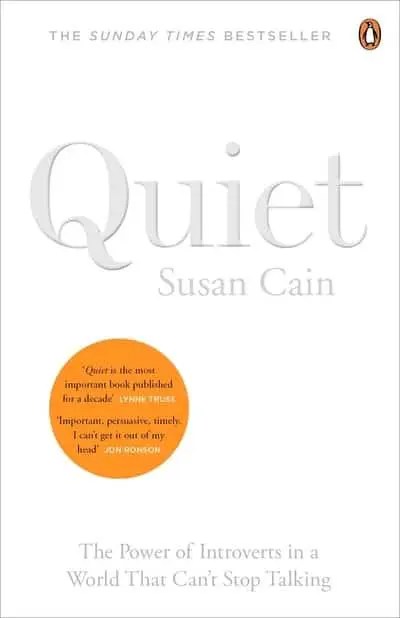
Before going into the content of the book, I want to make a short note on the cover of this book which stood out to me: it has the word “Quiet” on it, raised in white against a white background. I found this effective as it forces the reader to pay attention and really listen to something that is not obvious on the surface. It really set the tone for the rest of the book.
This book would be of most interest to all those who are aspiring to be inclusive leaders, those interested in personality, psychology, and those who feel introverted. It is well-written, easy to follow, relatively short at below 300 pages, and it is split into clear chapters which explore different parts of the personality and leadership.
This book is one of the most empowering that I have read. It had the potential to be clichéd by encouraging the reader to be true to themselves, but instead, Cain has produced a very impactful book. By going through different aspects of personality and leadership in professional and personal environments, including but not limited to soft power, temperament, charismatic leadership, Cain explains how society has misunderstood and underestimated the potential of introverts. Cain also addresses the concept of ‘The Extrovert Ideal’ – in other words, society’s bias towards advantaging extroverts in schools, workplaces, and attitudes towards quieter people. The book is very careers, professional, and school focused, with less focus on personal relations. This is a limitation of the book, but it does not take away from its message.
She also dispels some myths about introverts: they are not all social recluses who dislike parties or big business meetings. It is perfectly possible that they enjoy these activities – and perfectly possible that they do not. It is simply that introverts tend to perform best when they have the time and space to reflect over a problem, to work by themselves first before the group discussion, to recharge by themselves rather than with other people. She goes on to explain some practical tips for how society can embrace these qualities. For example, Cain uses the example of open plan offices, which often disadvantage introverts who perform better when they are able to work in their own space. She also gives the example of early schooling, where children are encouraged to be outgoing and are singled out if they are quieter or prefer not to play in a group. She explains that internalising this message from a young age can have long term, negative implications on children when they get older.
If the reader is introverted, this is the kind of book which would leave them feeling empowered and proud of their characteristics. Cain emphasises that introversion is not something that needs to be fixed; rather, it is an asset for those who have these traits and it should be embraced. For example, introverts make good listeners and this can be a real strength. She understands that it can be exhausting to make a personality more outgoing to live up to the way that society expects. In this way, Cain has written and revealed a lot of what introverts may think and feel, but have never expressed themselves.
If the reader is not introverted, this is still a very relevant book as Cain shares valuable insights for those aspiring to be inclusive leaders. She shares the advice that people should aim to stay true to themselves in their style of communication. They should trust their gut and find ways of communicating which feels natural, such as through writing.
Overall, this book is empowering and inspiring across all personality types to change the perception that society holds of people who have an introverted personality type.
Watch Susan Cain’s TED Talk on the same topic here.
Overall rating: ⭐⭐⭐⭐⭐
 Preeti Kaur